
- Performance
- Business
- GEM Cleaning
- MASOS
- Compare
- Space
- About
- Config kits
- Mint / Own / Share
- Game characters
- Connect
Star-Bee · GEM in space
Space challenges & solutions
Patent pending
What changes when a concentrating GEM leaves Earth — vacuum, lunar night, radiation, launch loads, dust — and how each challenge is addressed and verified.
Values are min / std / max; «calculated by Bot» values are design estimates, not test results.
Challenges and our approach
| Challenge | Why it matters | Our approach | How we verify |
|---|---|---|---|
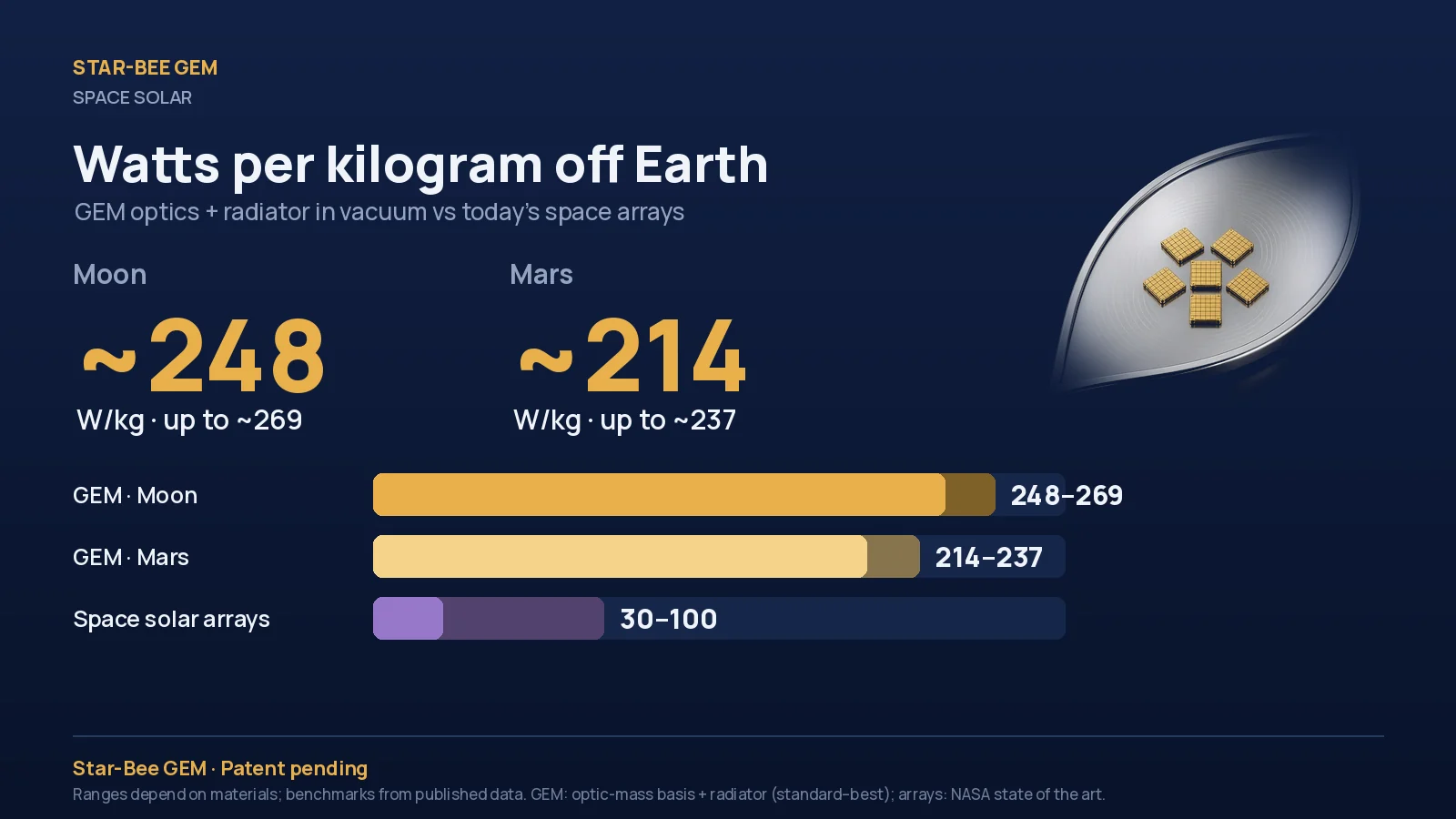
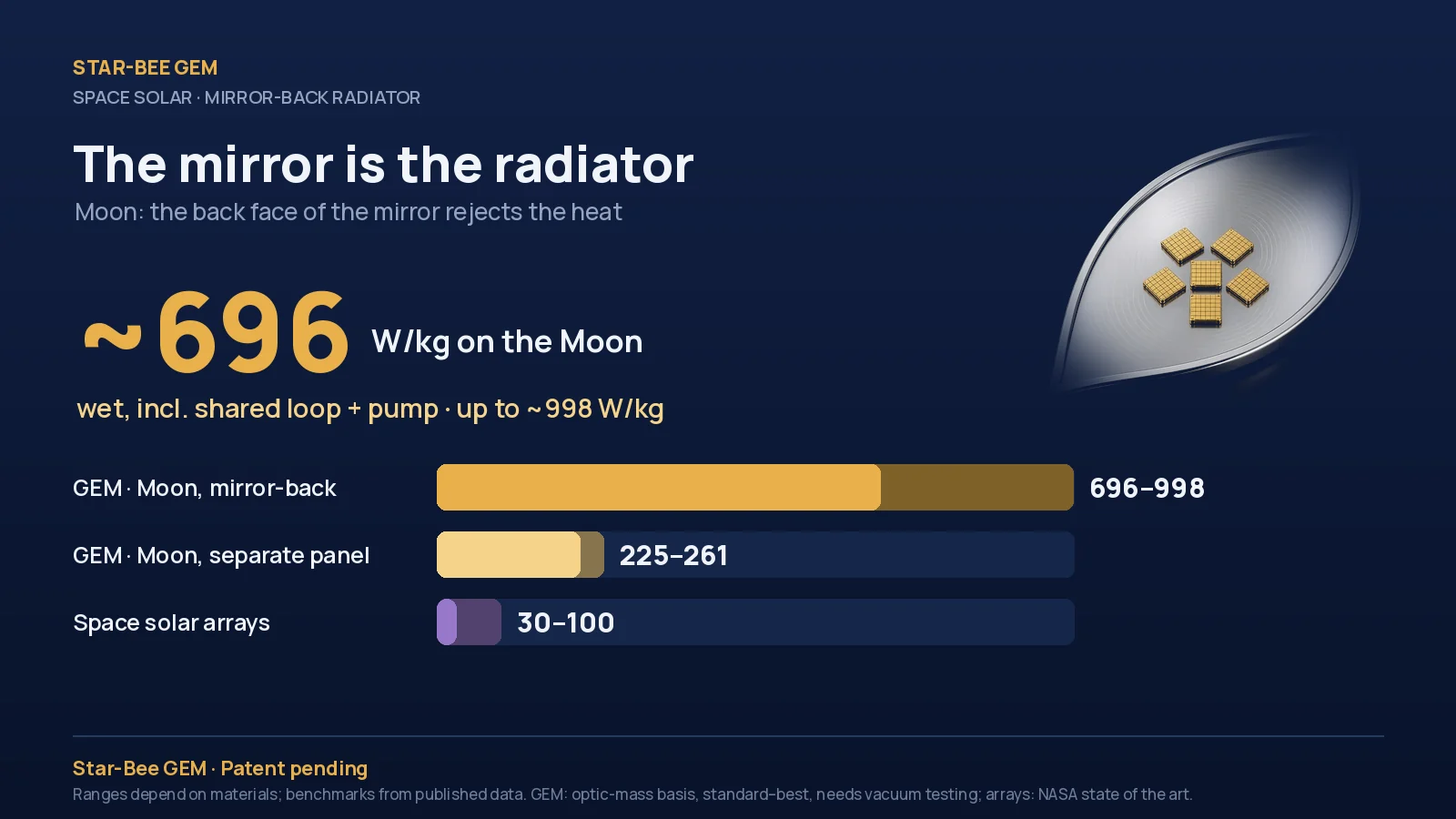
| Radiator mass in vacuum | No convection: a stand-alone radiating panel needs ~38× the Earth area. Moon optics + free-standing radiator: 65.8 / 248 / 269 W/kg (dry) | Use the mirror back face as the radiator, so only the overflow area needs a panel: Moon 153 / 982 / 1,130 W/kg dry, 129 / 696 / 998 W/kg with one shared coolant loop + pump per GEM «calculated by Bot». Deployable / heat-pipe radiators for any extra area | Thermal-vacuum balance test of a GEM segment |
| Coolant loop in space | A pumped loop adds mass, freezing and leak risks | ONE shared loop and ONE pump per GEM (not per module); passive dry / heat-pipe variant where possible; redundant pump | Loop tests in thermal vacuum; freeze / thaw cycling |
| Lunar night and eclipses | A 14-day lunar night or orbital eclipses stop power | Polar sites with long sunlight; a survival load instead of full power; batteries for short eclipses; optional heat storage only where heat is needed | Site illumination analysis; cycling tests on the mission profile |
| Radiation on cells and electronics | Cells and controllers degrade | Space-qualified multi-junction cells with doped cover glass; radiation-tolerant controllers, shielding and redundancy | Electron / proton irradiation of cells; dose and single-event tests of controllers |
| UV and atomic oxygen on mirrors | Reflectance can drop | Space-heritage protected mirror coatings with protective overcoats; no bare polymers on exposed faces | Combined UV / particle exposure of mirror coupons |
| Launch loads | Thin mirrors are sensitive to vibration and noise | Fly compact, supported stowed packs; launch locks; stiff sandwich panels; assemble in space where possible | Sine, random, acoustic and shock tests of a stowed pack |
| Deployment and focus | Mirrors must keep their shape and alignment | Modular / robotic assembly with kinematic mounts; repeatable hinges; focus trim with the existing actuators | Deployment repeatability and surface-figure checks in thermal vacuum |
| Outgassing and contamination | Vapours can fog mirrors and cells | Low-outgassing materials (ASTM E595 screen) or adhesive-free joints; bake-out; vents away from optics | ASTM E595 tests; bake-out monitoring; witness samples |
| Lunar and Mars dust | Dust is abrasive and cuts power | Built-in cleaning concept; electrodynamic dust shields (flight-proven on the Moon); stow during Mars dust storms | Regolith-simulant tests in vacuum / low-pressure CO₂ |
| Pointing accuracy | Concentrators need accurate sun tracking | Closed-loop sun sensors feeding the GEM actuators; pointing error budget | Sun-simulator tracking tests |
| Thermal cycling | Many hot / cold cycles in orbit | Matched-expansion materials, compliant mounts, brazed / welded joints | Thermal-cycling qualification of coupons |
| Complete mass budget | Frame, wiring and deployment mass are not yet counted, so space W/kg are lower-bound estimates | Full mass breakdown with growth allowance; sandwich panels as structure | Mass measurement of an engineering model |
Context: space flat PV arrays reach about 30–100 W/kg (NASA Small Spacecraft Technology State of the Art). GEM design optics: Moon 1,482 / 2,035 / 2,557 W/kg before radiator and structure.
Watts per kilogram off Earth
References
- NASA Small Spacecraft Technology State of the Art (power) https://www.nasa.gov/smallsat-institute/sst-soa/power-subsystems/
- NASA electrodynamic dust shield on the Moon https://ntrs.nasa.gov/api/citations/20250009407/downloads/EDS_ESA%20Newsletter%20paper%202025_Final_WithAuthors.pdf
- NASA GSFC outgassing database https://etd.gsfc.nasa.gov/capabilities/outgassing-database/user-guide/
- NASA ISAM https://ntrs.nasa.gov/citations/20250008988
- NASA ISS active thermal control overview https://nasa.gov/wp-content/uploads/2021/02/473486main_iss_atcs_overview.pdf
Full numbers: GEM vs flat PV vs CPV .