
- Performance
- Business
- GEM Cleaning
- MASOS
- Compare
- Space
- About
- Config kits
- Mint / Own / Share
- Game characters
- Connect
Star-Bee · GEM
GEM vs flat PV vs CPV
Patent pending
W/kg, W/m², cost per watt, LCOE and land per MW for Star-Bee GEM, utility flat PV, space flat PV and concentrator PV, plus the radiator (dry and wet), delivered cost to space and the optional thermal storage bus.
Values are min / standard / max where they depend on design options. Every benchmark is cited with URL and year. Values marked «calculated by Bot» are derived with the formula shown. Gaps say "— (no source)".
At a glance
Key caveats
- GEM $/W includes radiator, electrical layer and battery (0 / 4 / 5.29 h); flat-PV and CPV $/W are installed-system benchmarks (balance of system and labour, no battery). They are not like-for-like.
- The thermal storage bus is not part of the main comparison; it is a separate option sized to the use (section 3).
- Space-array $/W excludes launch unless the row says delivered (section 2).
- PV cost parity applies only to the GEM best case ($0.896/W). The standard case ($11.8/W) is above installed PV.
- In vacuum the radiator is the main mass item unless the mirror back face does the radiating; the mirror-back variant needs thermal-vacuum testing.
- On the Moon surface the GEM standard and max delivered cases cost more per watt than flat III-V arrays; delivered to LEO, GEO and Mars transfer orbit the GEM is cheaper.
- Delivered figures leave out frame, electrical layer, tracker and deployment mass, so they are lower bounds.
What each number includes (read before quoting)
- Main comparison = optics + cells + radiator (+ electrical layer and battery). The thermal storage bus is not part of the base system; it is a separate option (section 3).
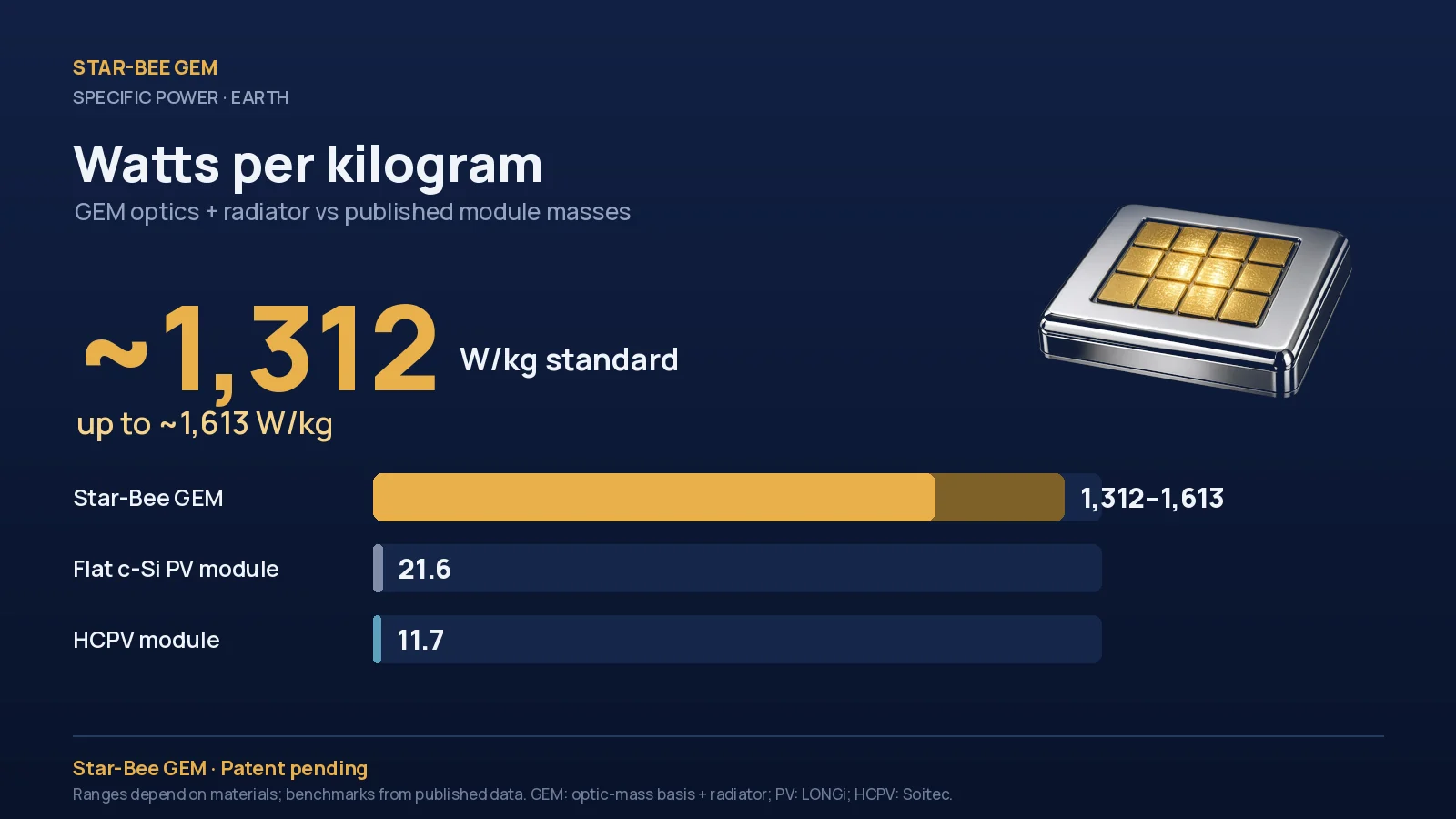
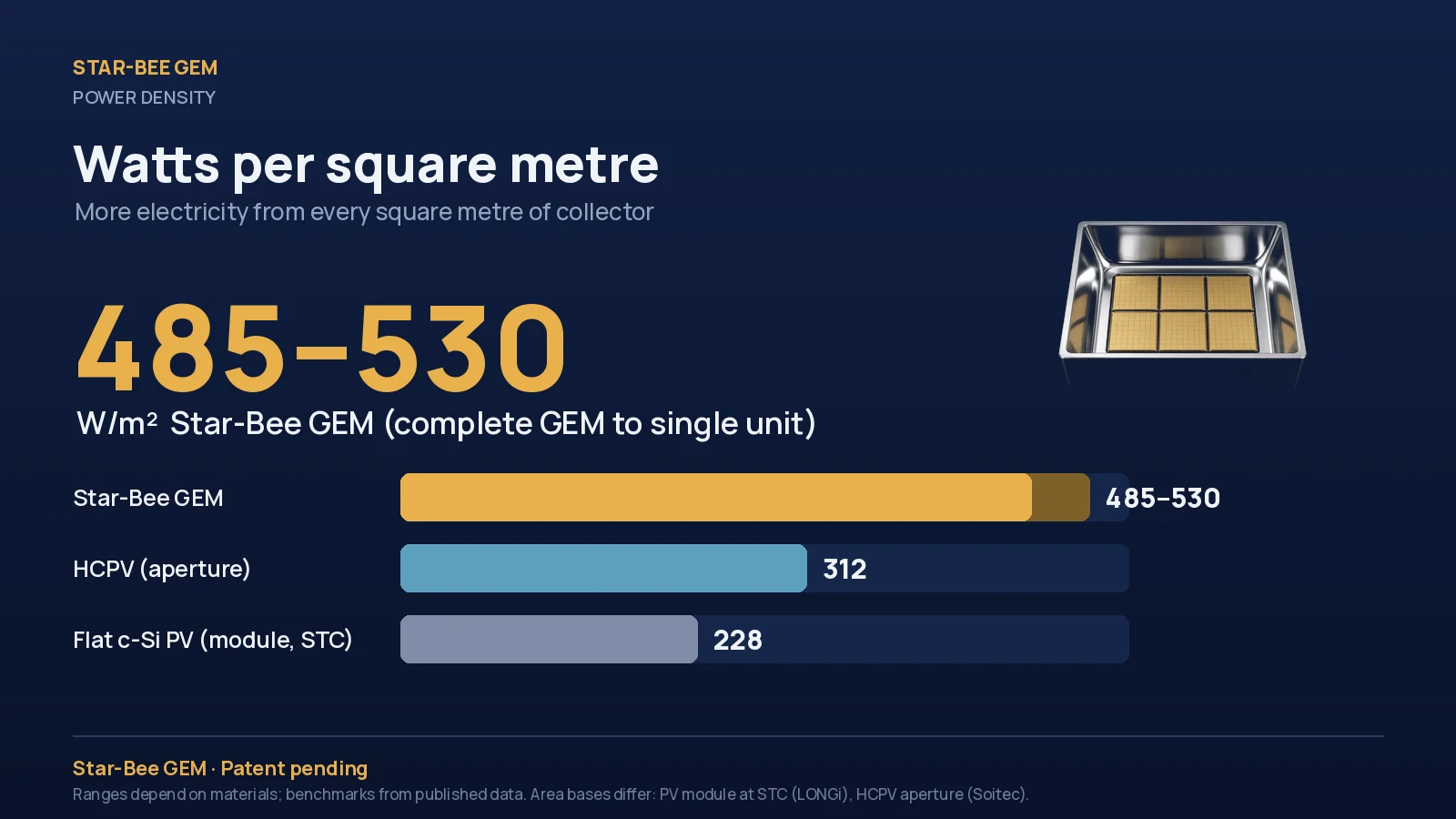
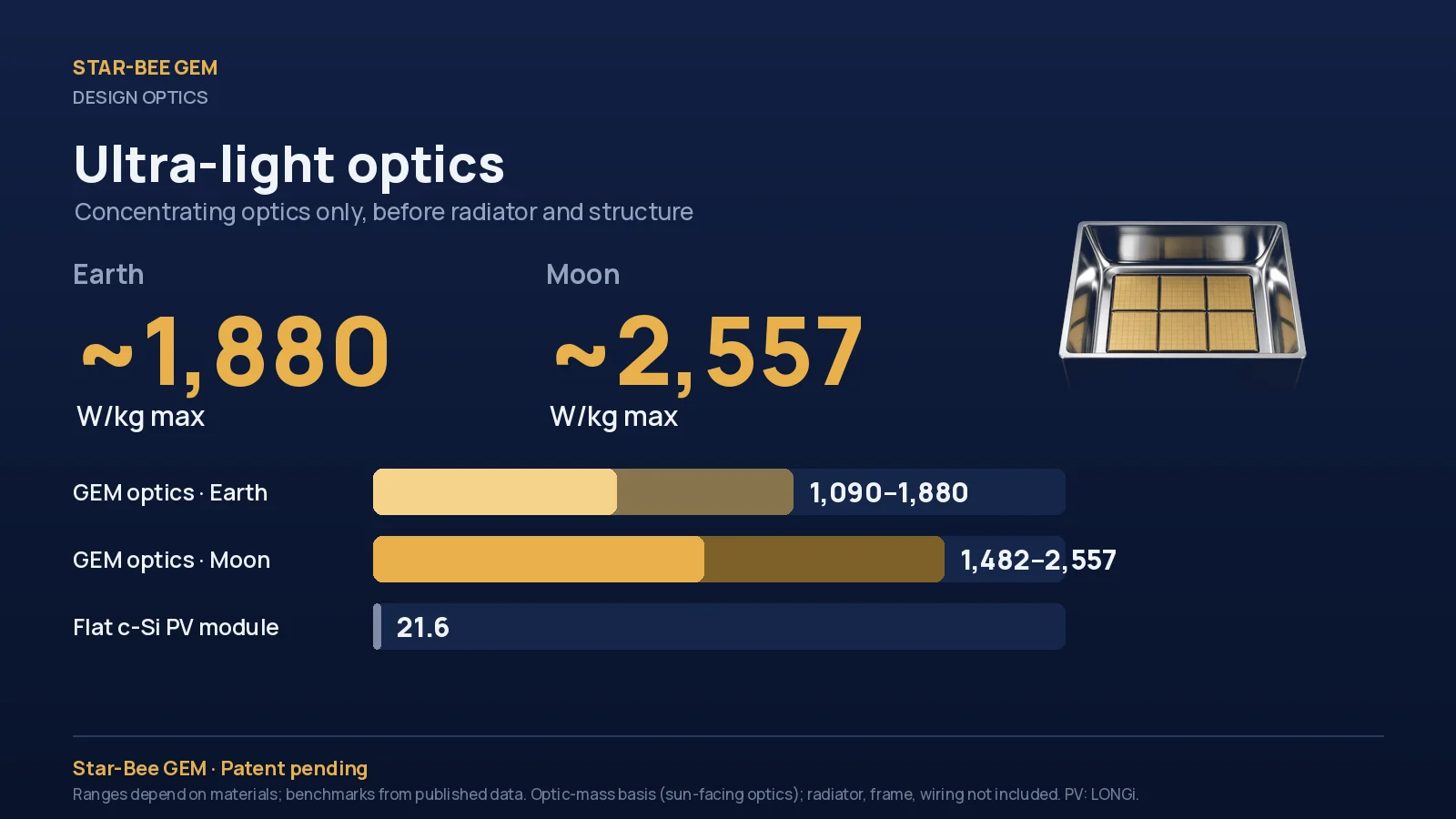
- Headline W/kg and W/m² are design specific-power figures on an optic-mass basis: pods ~1,090 W/kg (sourced design data) up to ~1,880 W/kg with the lightest film on Earth; about ×1.36 on the Moon and ×0.59 on Mars. Unit up to ~530 W/m², GEM with Glory up to ~485 W/m². Frame, tracker and electrical mass are not included.
- Radiator is computed component by component per 10 kW of heat: radiating area «calculated by Bot: heat ÷ cooling flux» × sandwich panel areal mass (1.80–5.00 kg/m²), panel only (dry). The wet case adds ONE shared coolant loop (piping, header, sensors, valves, tank, coolant) and ONE pump per GEM — not per module. The mirror plate doubles as the radiator base and is not counted twice.
- GEM $/W = optics + III-V cells + radiator + electrical layer + battery (0 / 4 / 5.29 h). Excludes frame, tracker, installation and launch. The W/kg-optimised and the cost-optimised designs are different options.
- GEM LCOE = (capex × CRF + O&M) ÷ (8,760 h × capacity factor); WACC 4.2 / 7.7 / 10 %, 30 years, O&M $19 / 22 / 30 per kW-yr, capacity factor Earth 17–31 %.
- Flat PV and CPV $/W are installed-system benchmarks (incl. balance of system and labour, no battery). Space array $/W excludes launch. € values stay in €.
1. Main comparison (no thermal bus)
| Metric | Star-Bee GEM (min / std / max) | Flat PV — utility c-Si (Earth) | Space flat PV (rigid III-V / ROSA-type) | HCPV (Soitec/Amonix class) | Notes |
|---|---|---|---|---|---|
| W/kg — design optics (headline) | Earth 1,090 / 1,496 / 1,880; Moon 1,482 / 2,035 / 2,557; Mars 643 / 883 / 1,109 | 21.6, module only [LONGi 2024] «calculated by Bot: 615 W ÷ 28.5 kg» | 30–60 rigid; 100 ROSA [NASA SoA 2026] | 11.7, module only [Soitec 2014] «calculated by Bot: 2,450 W ÷ 210 kg» | optic-mass basis |
| W/kg — optics + radiator | Earth 700 / 1,312 / 1,613; Moon 65.8 / 248 / 269; Mars 62.2 / 214 / 237 | — | — | — | «calculated by Bot: 1 ÷ (1/W/kg + radiator kg/W)»; dry = panel only; min end = heaviest panel |
| W/kg — optics + radiator, mirror back face as radiator | Earth 1,090 / 1,496 / 1,880; Moon 153 / 982 / 1,130; Mars 643 / 883 / 1,109 | — | — | — | only area beyond the mirror needs its own panel |
| W/m² — design | Earth 485 / 485 / 530; Moon 660 / 660 / 721; Mars 286 / 286 / 313 | 228, module at STC [LONGi 2024] | 384–433, cell at AM0 [NASA SoA 2026] | 312, aperture [Soitec 2014] | different area bases |
| $/W | Earth $0.896 / $11.8 / $37.2; Moon $0.648 / $11.2 / $34.9; Mars $1.28 / $19.6 / $72.8 | $0.691 [IRENA 2025]; $1.07–1.12/Wdc [DOE 2025]; $1.56/W_AC [NREL ATB 2024]; commercial $1.95 [DOE 2025] | $250–450/W cells [Surrey 2023] to ~$1,000/W arrays [ISM 2023], excl. launch | $1.95–1.98/Wdc, 250 kW [DOE 2025]; €1.4–2.2/Wp [CPV report 2015] | |
| LCOE $/kWh | Earth $0.0265 / $0.495 / $2.67; Mars $0.0319 / $0.852 / $7.38; Moon $0.00745 / $0.148 / $0.853 (excl. launch) | $0.043 [IRENA 2025]; $0.038–0.078 [Lazard 2025] | — (no source) | €0.08–0.15 [CPV report 2015] | |
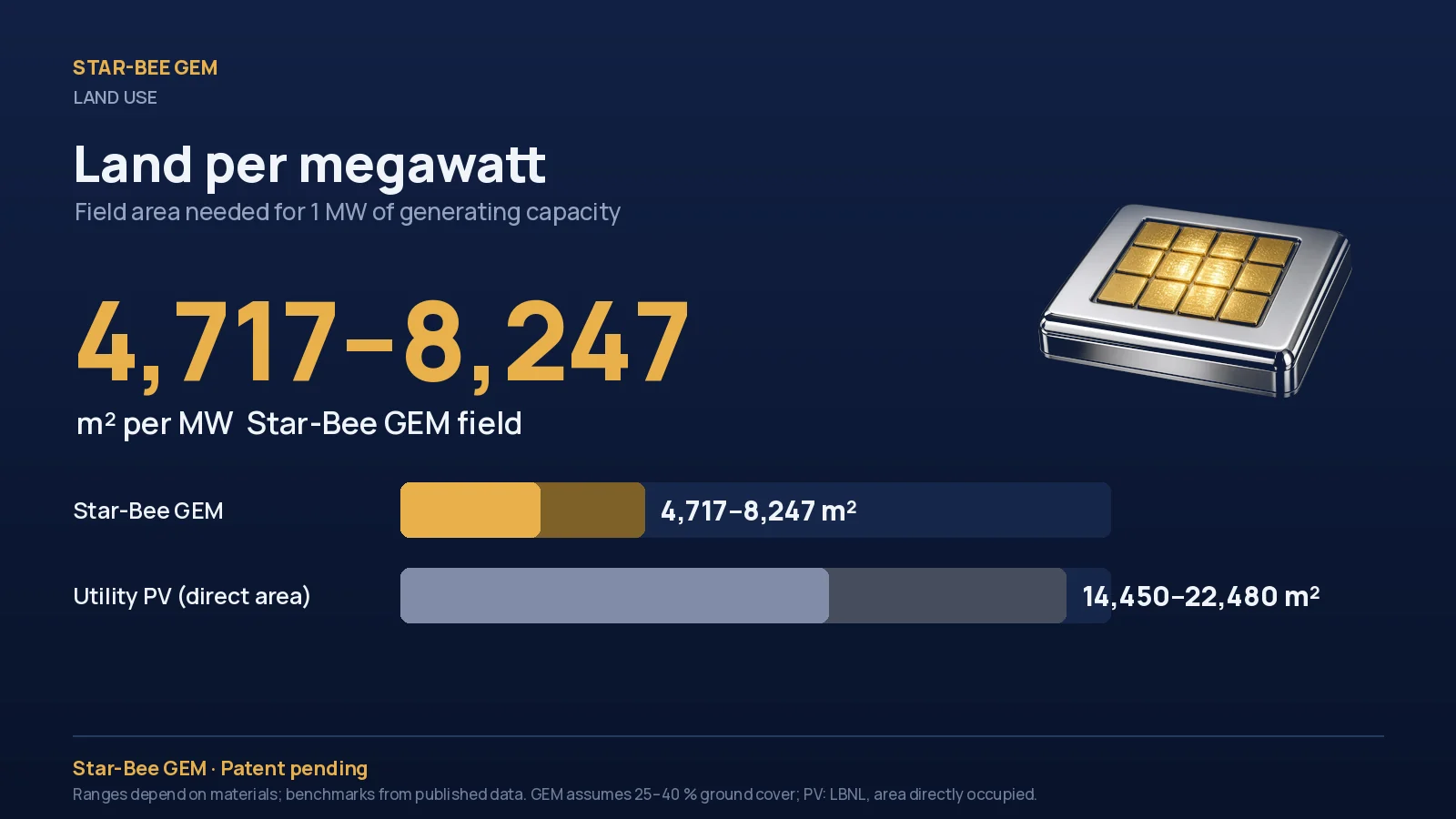
| Land per MW, m²/MW | Earth 4,717 / 6,344 / 8,247 «calculated by Bot: 10⁶ ÷ (W/m² × ground-cover 0.40 / 0.325 / 0.25)» | 14,450–22,480 direct [LBNL 2022]; 30,350–33,590 total [NREL 2013] | — | 32,780–36,830 total [NREL 2013] | ground-cover ratio is an assumption |
Radiator mass per 10 kW of heat «calculated by Bot» (min = lightest panel, best cooling, passive; std = reference stack 1.92 kg/m², panel only; max = 5.00 kg/m² panel, weakest cooling; all panel only = dry):
| Environment | Cooling flux W/m² (best – worst) | Total kg per 10 kW_th (min / std / max) | kg per kW of electricity |
|---|---|---|---|
| Earth | 31,584 – 15,840 | 0.587 / 0.626 / 3.41 | 0.0881 / 0.0939 / 0.512 |
| Moon | 838 – 559 | 22.1 / 23.6 / 96.8 | 3.32 / 3.54 / 14.5 |
| Mars | 838 – 559 | 22.1 / 23.6 / 96.8 | 3.32 / 3.54 / 14.5 |
| Orbit | 1,676 – 559 | 11.1 / 23.6 / 96.8 | 1.66 / 3.54 / 14.5 |
On Earth the radiator is well under a kilogram per 10 kW of heat at the standard end. In vacuum (Moon, orbit) there is no convection, so a stand-alone radiating panel needs ~38× more area; using the mirror back face as the radiator removes most of that mass.
1b. Radiator: dry vs wet (one shared loop + pump per GEM)
Dry = radiator panel only. Wet = dry panel + one shared coolant loop per GEM (23.1–32.6 kg hardware + 2.20–2.77 kg coolant) + one pump. The loop is counted once per GEM, never per module.
| Pump per GEM (published datasheet mass) | Light | Standard | Heavy |
|---|---|---|---|
| Earth | 21.5 kg — Grundfos MAGNA3 65-120 F | 30.5 kg — Wilo Stratos MAXO 65/0,5-12 PN6/10 | 34.2 kg — Grundfos TP 65-120/2 A-F-A-BQQE |
| Moon / Mars / orbit | 11 kg — ESA / Bradford MPFL pump assembly | 106.7 kg — ISS Pump and Flow Control Subassembly | 353.8 kg — ISS EATCS Pump Module |
No flight pump is published at this heat load, so the space values use one published pump package (a lower bound). Pump prices are not published; the cost uses source pump costs.
| W/kg (min / std / max) | Optics + radiator, dry | Wet, excl. pump | Wet, incl. pump | Mirror-back radiator, dry | Mirror-back radiator, wet incl. pump |
|---|---|---|---|---|---|
| Earth | 700 / 1,312 / 1,613 | 633 / 1,145 / 1,367 | 579 / 995 / 1,214 | 1,090 / 1,496 / 1,880 | 823 / 1,098 / 1,359 |
| Moon | 65.8 / 248 / 269 | 65.4 / 243 / 264 | 60.9 / 225 / 261 | 153 / 982 / 1,130 | 129 / 696 / 998 |
| Mars | 62.2 / 214 / 237 | 61.3 / 206 / 227 | 52.9 / 177 / 223 | 643 / 883 / 1,109 | 228 / 476 / 854 |
| Orbit | 65.8 / 248 / 488 | 65.4 / 243 / 469 | 60.9 / 225 / 461 | 153 / 982 / 1,130 | 129 / 696 / 998 |
| Radiator per GEM, kg (lightest / std / heaviest) | Dry | Wet incl. loop, coolant and pump |
|---|---|---|
| Earth | 20.5 / 21.8 / 119 | 67.8 / 78.2 / 188 |
| Moon | 1,049 / 1,119 / 4,587 | 1,086 / 1,252 / 4,975 |
| Mars | 455 / 485 / 1,990 | 492 / 618 / 2,378 |
| Orbit | 525 / 1,119 / 4,587 | 561 / 1,252 / 4,975 |
| $/W full system (min / std / max) | Dry | Wet |
|---|---|---|
| Earth | $0.896 / $11.8 / $37.2 | $0.905 / $11.8 / $37.3 |
| Moon | $0.648 / $11.2 / $34.9 | $0.655 / $11.2 / $35.0 |
| Mars | $1.28 / $19.6 / $72.8 | $1.30 / $19.7 / $72.9 |
Mirror-back space variant: the back face of the mirror plate is the radiator, so only the area beyond the mirror needs its own panel. In vacuum this is the main design lever (it needs thermal-vacuum testing). Space flat PV arrays: 30–100 W/kg [NASA SoA 2026].
2. Delivered to space (launch included) — per watt
Delivered $/W «calculated by Bot» = hardware $/W + launch $/kg × kg/W. Launch $/kg = published price ÷ capability «calculated by Bot». Starship is an announced target, not a price. Frame, electrical layer, tracker and deployment mass are not included, so these are lower bounds.
| Destination | Launch $/kg (min / std / max) | GEM kg/W | GEM delivered $/W (with battery) | GEM delivered, no battery | GEM delivered, mirror-back radiator | GEM delivered, wet incl. pump | GEM delivered, mirror-back wet | Flat III-V array delivered $/W |
|---|---|---|---|---|---|---|---|---|
| LEO | $100 / $1,520 / $3,364 | 0.00438 / 0.00695 / 0.0199 | $1.20 / $21.1 / $98.9 | eclipse battery kept | $1.09 / $16.5 / $69.7 | $1.22 / $21.7 / $103 | $1.11 / $17.1 / $73.9 | $251 / $475 / $1,112 |
| GEO (priced to GTO) | $3,633 / $13,455 / $13,455 | 0.00685 / 0.0100 / 0.0248 | $25.8 / $146 / $366 | eclipse battery kept | $21.5 / $105 / $249 | $26.2 / $151 / $383 | $22.0 / $111 / $266 | $286 / $674 / $1,448 |
| Moon surface | $1,200,000 / $1,200,000 / $1,200,000 | 0.00371 / 0.0240 / 0.0575 | $4,454 / $28,850 / $69,046 | $4,454 / $4,850 / $18,258 | $1,063 / $25,233 / $58,637 | $4,594 / $29,354 / $70,521 | $1,203 / $25,736 / $60,112 | $12,250 / $20,450 / $41,000 |
| Mars (transfer orbit only; landed — no source) | $5,774 / $5,774 / $18,408 | 0.00422 / 0.0247 / 0.0584 | $25.7 / $162 / $1,148 | $25.7 / $45.8 / $365 | $6.49 / $142 / $880 | $27.2 / $168 / $1,200 | $8.06 / $147 / $933 | $715 / $1,269 / $3,748 |
Launch bases: LEO — Starship announced <$10M per ~100 t (min), Falcon Heavy $97M ÷ 63.8 t (std), Falcon 9 $74M ÷ 22 t (max). GTO — Falcon Heavy $97M ÷ 26.7 t, Falcon 9 $74M ÷ 5.5 t. Moon — commercial lander $1.2M/kg. Mars — Falcon Heavy $97M ÷ 16.8 t, Falcon 9 $74M ÷ 4.02 t to transfer orbit. Flat III-V: ROSA 100 W/kg & $250/W (min) … rigid 30 W/kg & $1,000/W (max).
3. Thermal storage option — equal service (electricity + heat)
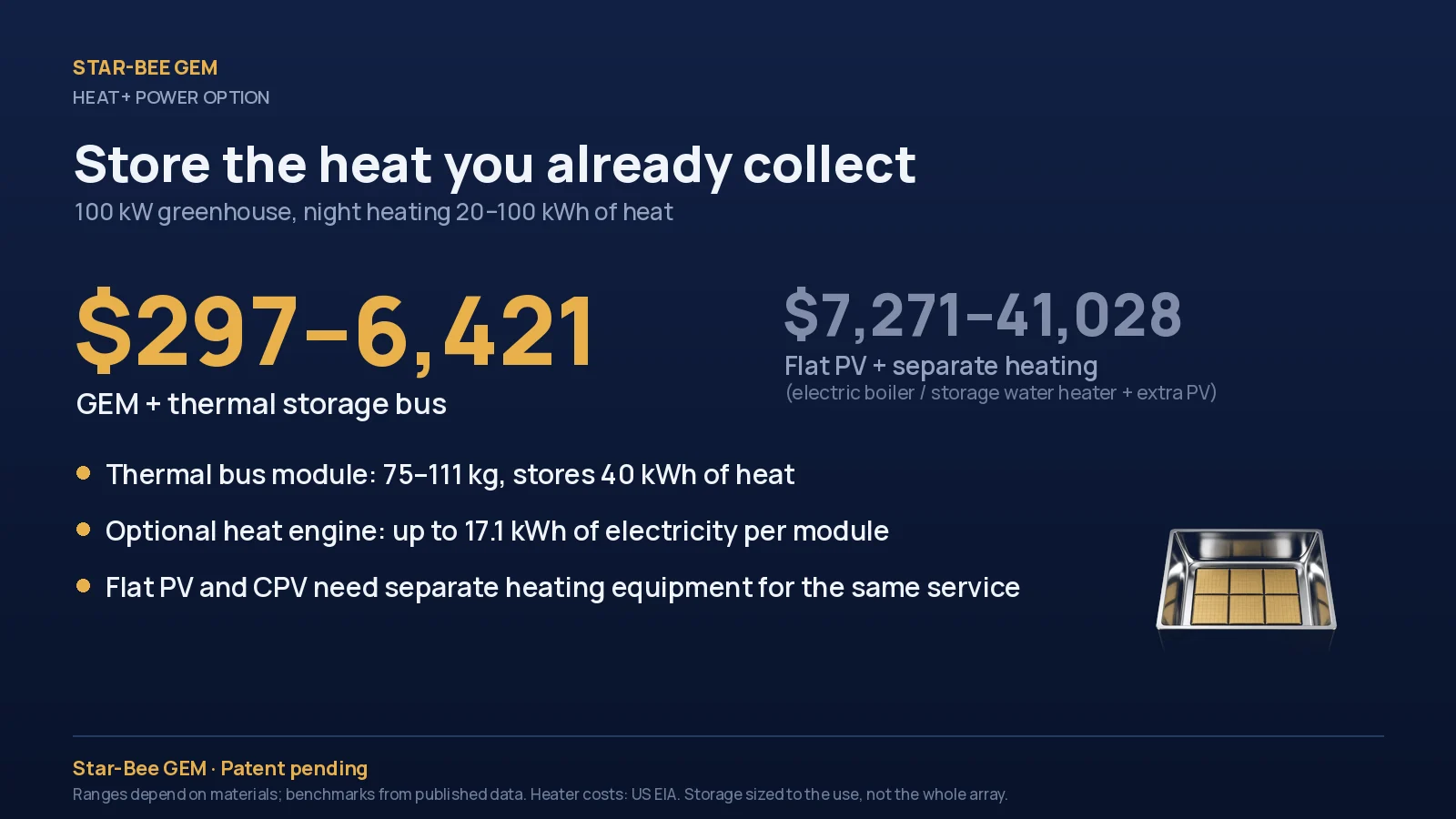
The thermal bus is optional and sized to the use, not to the whole array. One module stores 40 kWh of heat (10 kW for 4 h), weighs 75.0–111 kg and costs $594–2,568 «calculated by Bot: storage + heat exchanger»; an optional engine turns one module's heat into 17.1 kWh of electricity. Flat PV and CPV need a separate heater plus extra PV to make the same heat «calculated by Bot: heater $/kW × kWh ÷ 4 h + kWh ÷ (efficiency × 24 h × 0.24) × PV $/W». Heater benchmarks [EIA 2023, installed]: electric boiler $72/kW of heat (98 %), electric resistance storage water heater $259/kW (tank included), heat pump water heater $1,199/kW (COP 3.9; tank extra — no source). Heater mass and space heat-storage mass: — (no source).
| Scale / site | Use case assumed | Heat stored kWh | Modules | GEM bus kg | GEM bus $ | Flat PV + separate heating $ | CPV + heating $ | Space only: GEM bus launch $ | Space only: extra PV array launch $ (its heat storage — no source) |
|---|---|---|---|---|---|---|---|---|---|
| 100 kW Earth | Greenhouse night heating | 20.0–100 | 0.500–2.50 | 37.5–278 | $297–6,421 | $7,271–41,028 | $7,271–41,560 | — | — |
| 150 kW Earth | Home residence storage | 75.0–150 | 1.88–3.75 | 141–416 | $1,114–9,631 | $27,267–61,542 | $27,267–62,339 | — | — |
| 250 kW Earth | Office building peak-shave | 500–1,500 | 12.5–37.5 | 938–4,163 | $7,426–96,313 | $181,778–615,422 | $181,778–623,394 | — | — |
| 1 MW Earth | Office building / Mars-type buffer | 800–2,000 | 20.0–50.0 | 1,500–5,550 | $11,882–128,417 | $112,416–738,289 | — (no source) | — | — |
| 10 MW Earth | Community general hospital (96 h) | 15,000–20,000 | 375–500 | 28,125–55,500 | $222,785–1,284,167 | $2,107,794–7,382,889 | — (no source) | — | — |
| 100 kW Moon | Lunar habitat survival bus | 30.0–300 | 0.750–7.50 | 56.3–833 | $446–19,263 | $418,474–16,738,979 (extra space array) | — (no source) | $67,500,000–999,000,000 | $20,086,775–669,559,162 |
| 1 MW Moon | Lunar habitat, full 14-day night at 20-40 kWe (same for a 1 MW or 10 MW array: storage is per habitat, not per array) | 6,720–13,440 | 168–336 | 12,600–37,296 | $99,808–862,960 | $93,738,283–749,906,262 (extra space array) | — (no source) | $15,120,000,000–44,755,200,000 | $4,499,437,570–29,996,250,469 |
| 100 kW Mars | Mars dust-storm buffer (same for a 100 kW or 1 MW array) | 50.0–100 | 1.25–2.50 | 93.8–278 | $743–6,421 | $5,366,676–42,933,407 (extra space array) | — (no source) | $541,295–5,108,209 | $1,239,447–26,343,882 |
| 10 MW Mars | Mars buffer, 1 MWh class | 1,000 | 25.0 | 1,875–2,775 | $14,852–64,208 | $107,333,518–429,334,072 (extra space array) | — (no source) | $10,825,893–51,082,090 | $24,788,932–263,438,817 |
| 1 MW Orbit | LEO: no bus (batteries) | 0 | 0 | 0 | 0 | — | — | — | — |
Honest reading: on design optics the GEM is ~50–90× lighter per watt than a c-Si module and 10–60× lighter than space arrays; on Earth the radiator barely changes that. In vacuum the radiator is the main mass item unless the mirror back face does the radiating. Delivered to LEO, GEO and Mars the GEM is far cheaper per watt than flat III-V arrays; on the Moon the battery and radiator decide. Where heat is also wanted on Earth, storing the GEM's own heat costs far less than separate heating equipment plus extra PV. In space the launch of the storage mass dominates; the flat-PV side then also needs its own heat storage (no public mass figure), so that comparison stays open.
Sources
- [IRENA] IRENA, Renewable Power Generation Costs in 2024, 2025. https://www.irena.org/Publications/2025/Jun/Renewable-Power-Generation-Costs-in-2024
- [DOE] US DOE / NREL PV system cost benchmarks Q1-2025 (modeled, MSP/MMP), 2025. https://www.energy.gov/cmei/systems/solar-photovoltaic-system-cost-benchmarks
- [ATB] NREL ATB 2024, utility-scale PV (Moderate, 2023 $), 2024. https://atb.nrel.gov/electricity/2024/utility-scale_pv
- [LAZ] Lazard LCOE+ (June 2025), utility solar unsubsidised, 2025. https://www.lazard.com/media/uounhon4/lazards-lcoeplus-june-2025.pdf
- [LONGI] LONGi Hi-MO X6 Max LR7-72HTH-615M datasheet, 2024. https://longi-solar.net/datasheets-pdf/hi-mo-x6-max-explorer-lr7-72hth-605-615m-30-30-15frame.pdf
- [LBNL] LBNL (Bolinger & Bolinger), Land requirements for utility-scale PV, 2022. https://emp.lbl.gov/publications/land-requirements-utility-scale-pv
- [NRELLU] NREL TP-6A20-56290, Land-use requirements for solar power plants in the US, 2013. https://docs.nlr.gov/docs/fy13osti/56290.pdf
- [CPVR] Fraunhofer ISE & NREL, Current Status of Concentrator Photovoltaic (CPV) Technology v1.1 (TP-6A20-63916), 2015. https://www.nrel.gov/docs/fy15osti/63916.pdf
- [SOITEC] Soitec CX-M500 CPV module technical data sheet, 2014. https://www.sandiegocounty.gov/content/dam/sdc/pds/ceqa/Soitec-Documents/Final-EIR-Files/references/2014-01-29-Soitec-Technical-Data-Sheet.pdf
- [NASASOA] NASA Small Spacecraft Technology State of the Art, Power Subsystems (updated 7 May 2026), 2026. https://www.nasa.gov/smallsat-institute/sst-soa/power-subsystems/
- [SURREY] University of Surrey news: III-V space cells cost $250-450/W, 2023. https://www.surrey.ac.uk/news/silicon-solar-cells-could-cut-satellite-power-costs-90-cent
- [ISM] Feasibility Analysis of Commercial In-Space Manufacturing Applications (space arrays ~$1,000/W), 2023. https://europeanspaceflight.com/wp-content/uploads/2023/05/Feasibility-Analysis-of-Commercial-In-Space-Manufacturing-Applications.pdf
- [EIA23] US EIA, Updated Buildings Sector Appliance and Equipment Costs and Efficiencies, Appendix A (2022$; commercial electric boiler, electric resistance storage water heater, heat pump water heater), 2023. https://www.eia.gov/analysis/studies/buildings/equipcosts/pdf/appendix-a.pdf
- [SPX] SpaceX Capabilities & Services (Falcon 9 $74M; F9/FH performance), 2026. https://www.spacex.com/assets/media/Capabilities%26Services.pdf
- [FH] Falcon Heavy, published $97M price and performance (Wikipedia summary of SpaceX data), 2022. https://en.wikipedia.org/wiki/Falcon_Heavy
- [SS] CNBC: Musk says Starship launch could cost <$10M for ~100 t (ANNOUNCED target, not a price), 2022. https://www.cnbc.com/2022/02/11/elon-musk-spacexs-starship-is-solution-to-efficient-space-travel.html
- [AST] Astrobotic Peregrine/Griffin Payload User Guide: lunar surface $1.2M/kg, 2022. https://www.astrobotic.com/wp-content/uploads/2022/01/PUGLanders_011222.pdf
- [NOAA] NOAA OSPO: GOES eclipse seasons (up to 72 min/day), 2024. https://www.ospo.noaa.gov/operations/goes/eclipse.html