
- Performance
- Business
- GEM Cleaning
- MASOS
- Compare
- Space
- About
- Config kits
- Mint / Own / Share
- Game characters
- Connect
Star-Bee · GEM · business overview
Business overview
Patent pending
Concentrating solar power that weighs a fraction of today’s panels — built for Earth, the Moon and Mars.
Star-Bee GEM concentrating solar technology. Inventor: Fateme Azad Dehghan. Patent pending. Values are shown as min / standard / max across the published design options. Values marked «calculated by Bot» are derived with the formula given; competitor figures are published benchmarks.
1. Key metrics
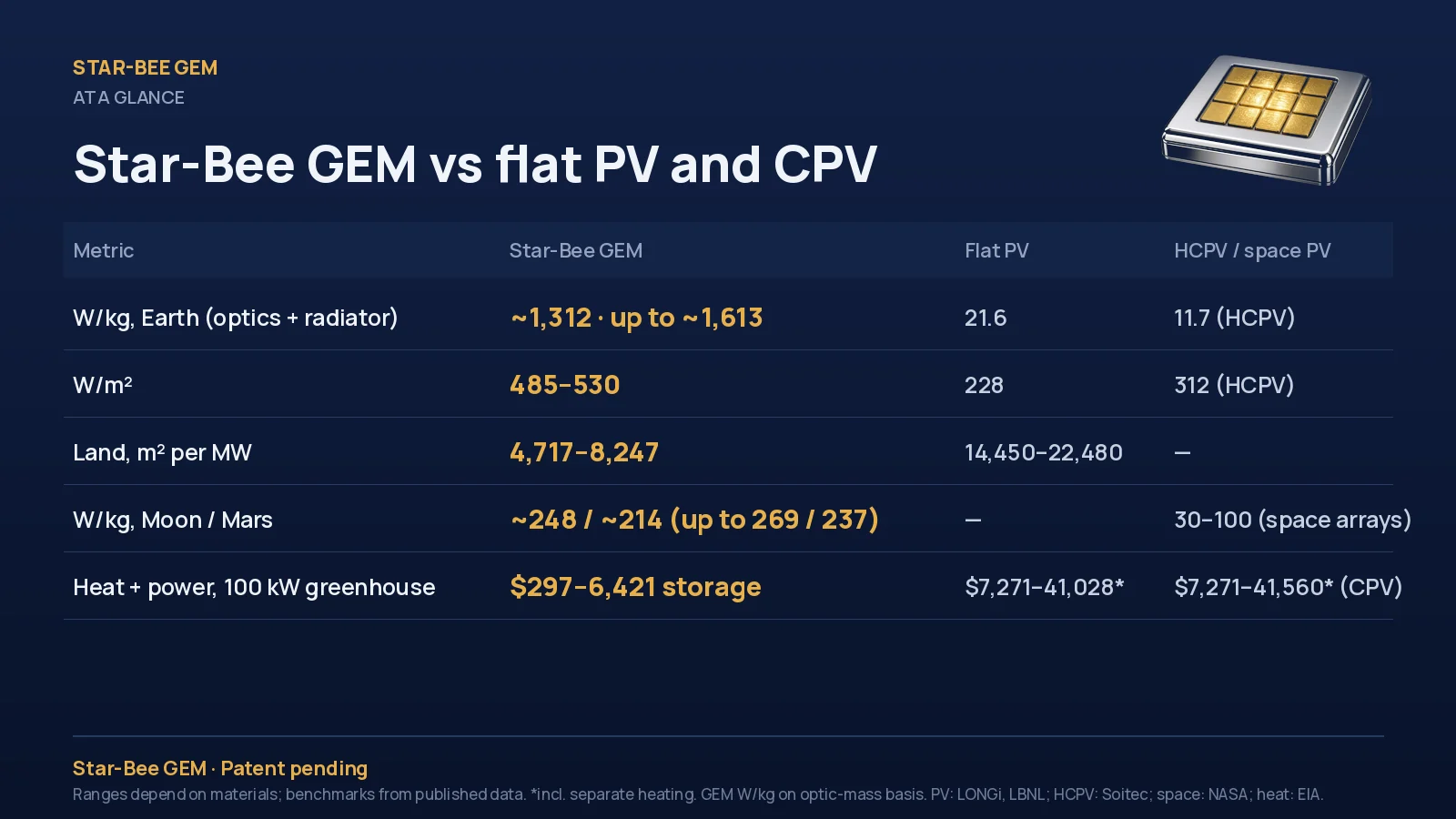
| Metric (min / std / max) | Earth | Moon | Mars | Orbit (LEO / GEO) |
|---|---|---|---|---|
| Design optics, W/kg | 1,090 / 1,496 / 1,880 | 1,482 / 2,035 / 2,557 | 643 / 883 / 1,109 | 1,482 / 2,035 / 2,557 |
| Optics + radiator, dry, W/kg | 700 / 1,312 / 1,613 | 65.8 / 248 / 269 | 62.2 / 214 / 237 | 65.8 / 248 / 488 |
| Optics + radiator, wet incl. pump, W/kg | 579 / 995 / 1,214 | 60.9 / 225 / 261 | 52.9 / 177 / 223 | 60.9 / 225 / 461 |
| Mirror-back radiator, dry, W/kg | 1,090 / 1,496 / 1,880 | 153 / 982 / 1,130 | 643 / 883 / 1,109 | 153 / 982 / 1,130 |
| Mirror-back radiator, wet incl. pump, W/kg | 823 / 1,098 / 1,359 | 129 / 696 / 998 | 228 / 476 / 854 | 129 / 696 / 998 |
| Power per area, W/m² | 485 / 485 / 530 | 660 / 660 / 721 | 286 / 286 / 313 | 660 / 660 / 721 |
| Full system, $/W (no launch) | $0.896 / $11.8 / $37.2 | $0.648 / $11.2 / $34.9 | $1.28 / $19.6 / $72.8 | — |
| LCOE, $/kWh | $0.0265 / $0.495 / $2.67 | $0.00745 / $0.148 / $0.853 | $0.0319 / $0.852 / $7.38 | — |
| Land per MW, m² | 4,717 / 6,344 / 8,247 | — | — | — |
Benchmarks: flat c-Si PV module 21.6 W/kg and 228 W/m² (LONGi datasheet); space solar arrays 30–100 W/kg (NASA Small Spacecraft Technology State of the Art); installed utility PV $0.691/W (IRENA).
The best-$/W blocks (standard, Earth)
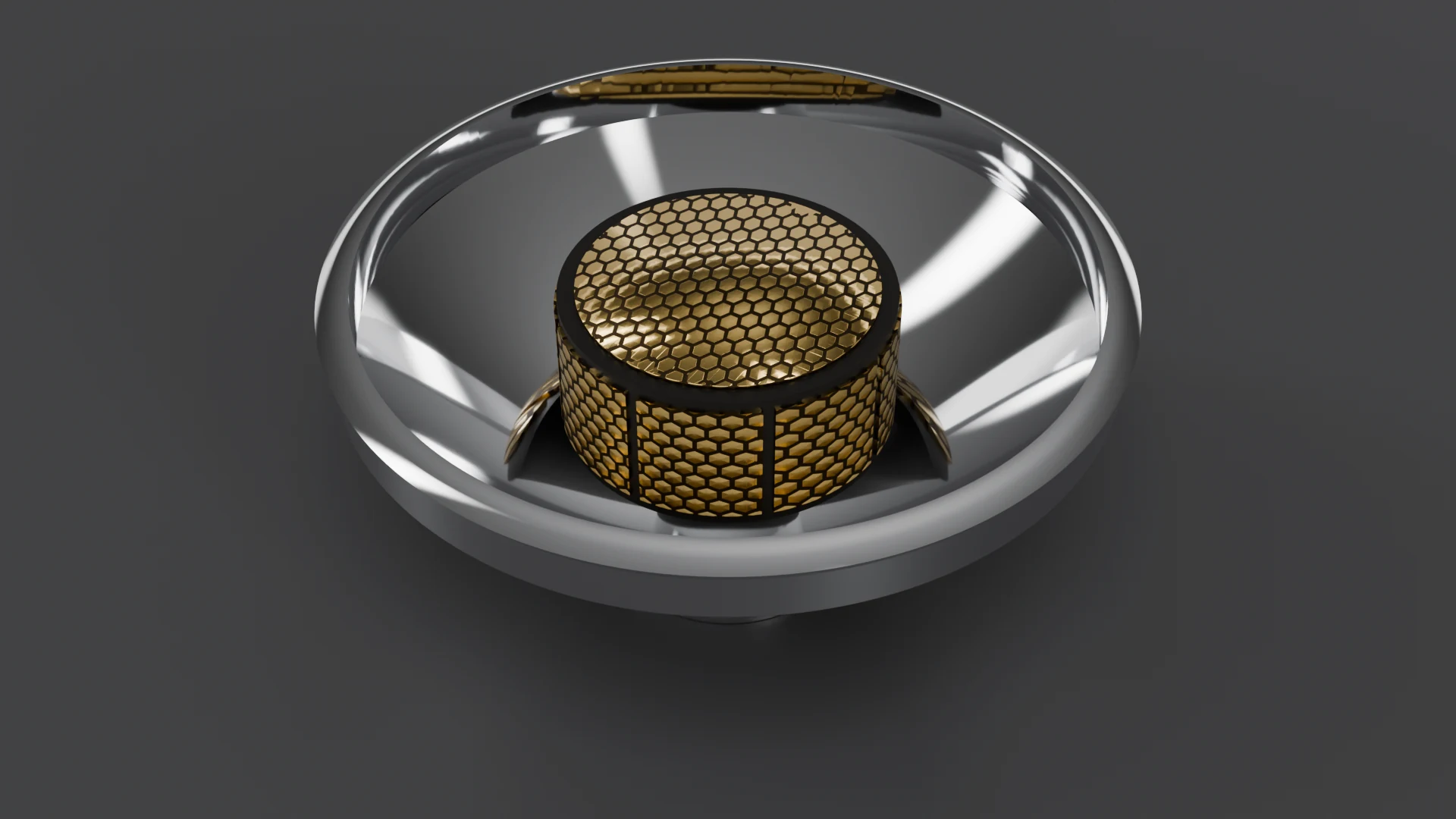
1 · Pod
Pod G4.3
48.1 W · 9 cells
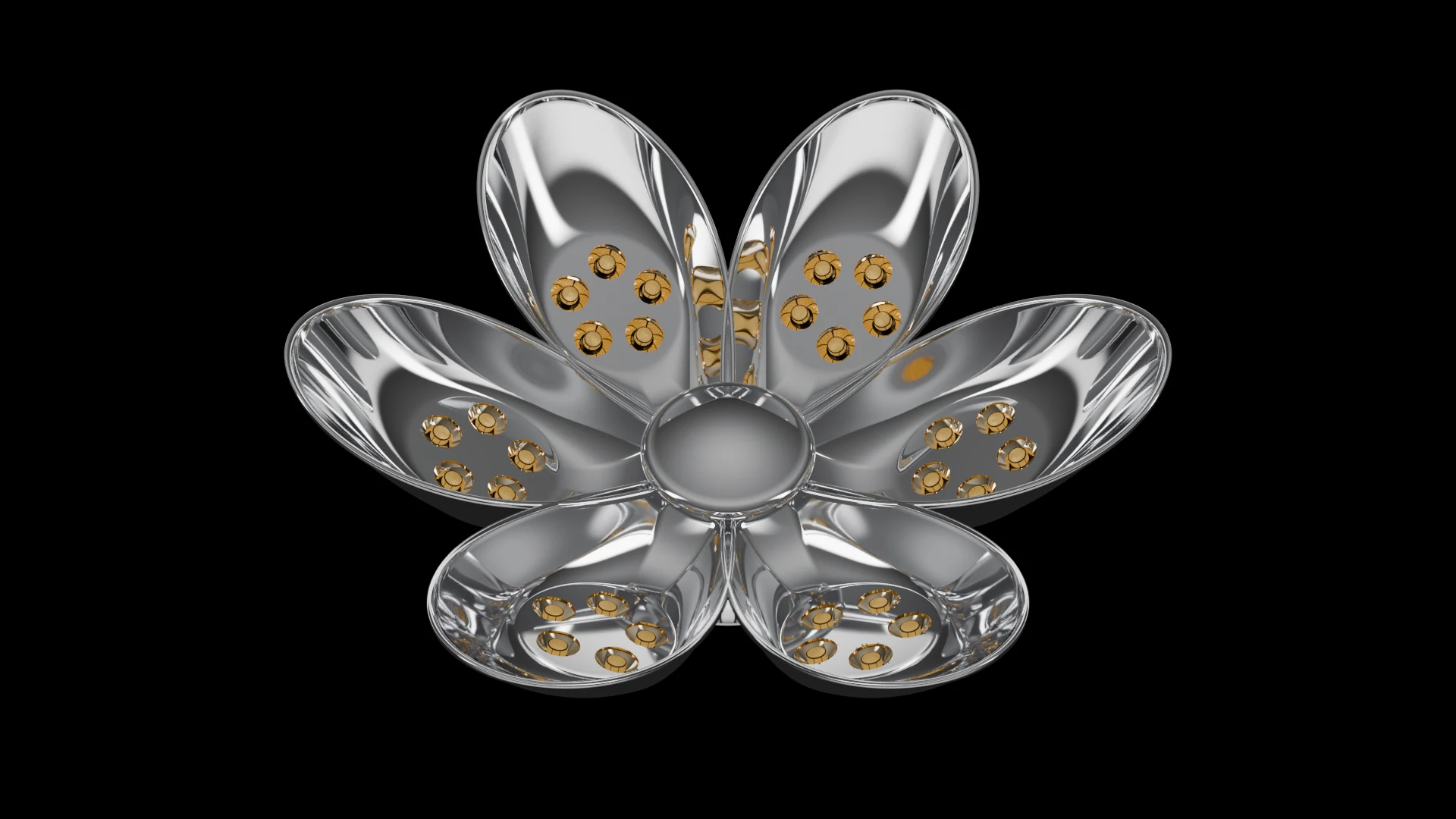
2 · Tile
Tile F4-G4.3
626 W · 13 pods · 117 cells
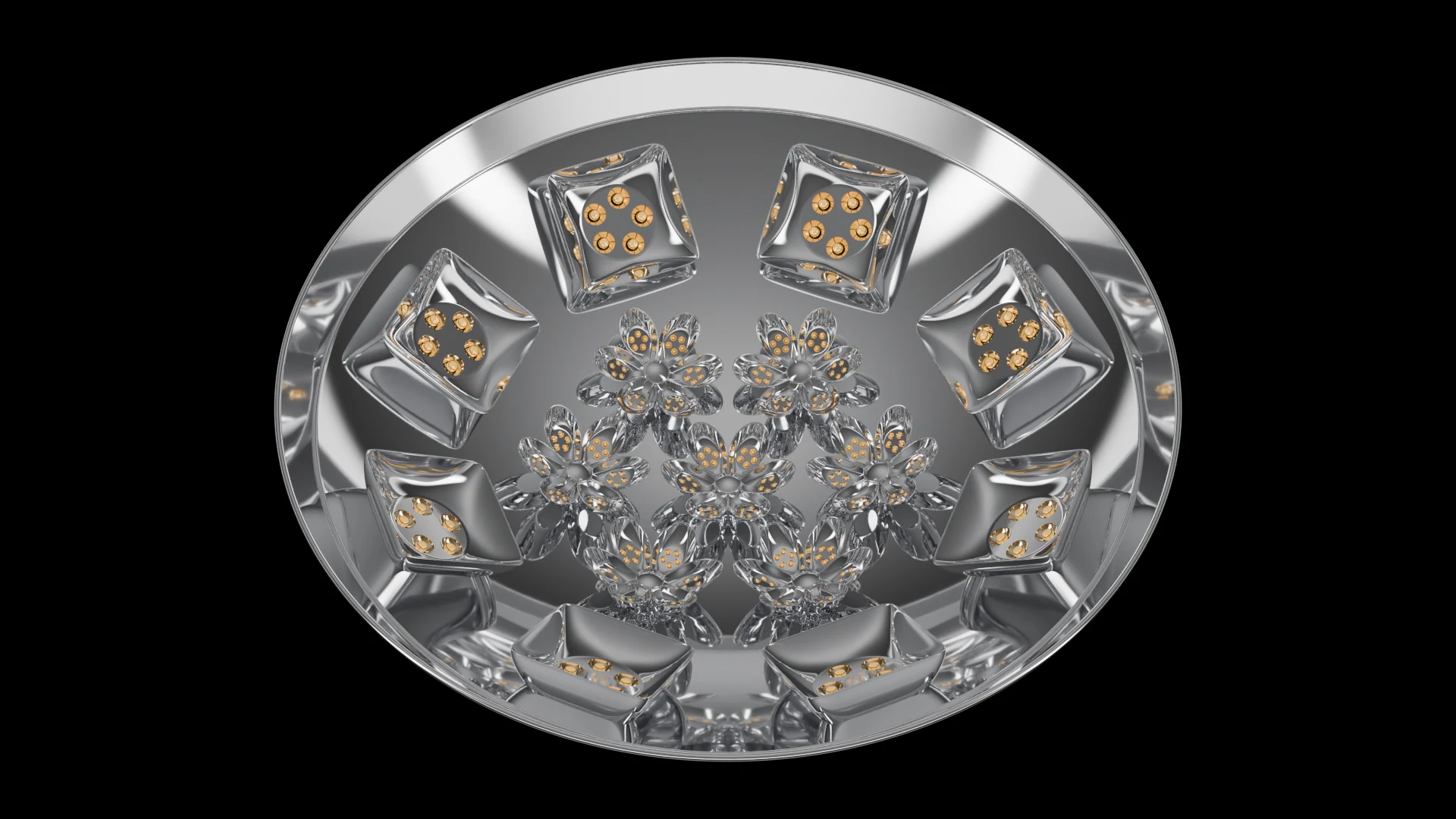
3 · Unit
Unit U10A
13.7 kW · 15 tiles · 285 pods
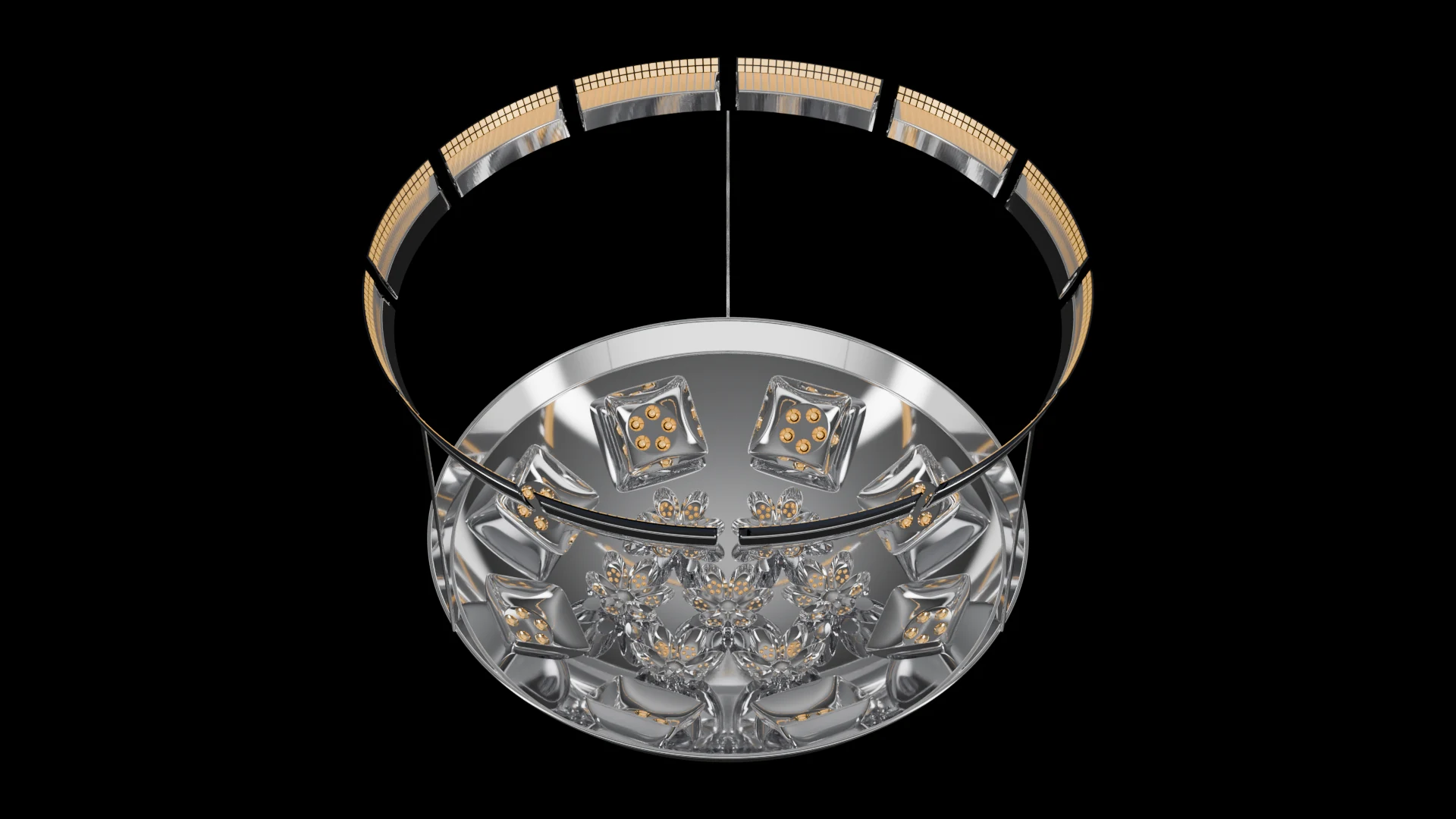
4 · GEM
GEM U10A (+ Glory)
15.7 kW · 2,745 cells
2. The GEM U10A block
A GEM is one Hybrid Bowl-Dish Unit U10A (15 tiles, 285 pods) plus its Glory halo mirror. Two published configurations are used, each for its own purpose:
| GEM U10A | Power per GEM (min / typical / max) | Specific power, W/kg | Used for |
|---|---|---|---|
| Field configuration (bottom-up design sheet) | 5.56 / 15.7 / 32.1 kW | 137 / 140 / 259 (whole unit + Glory optic mass) | farm sizing and $/W (sections 3–4) |
| High-concentration fixed design | 232 kW (Earth); Moon ×1.36, Mars ×0.59 | 1,496 | headline specific power and radiator sizing (section 1) |
The two are different design cases of the same block (different pod type and concentration), not an update of one another; each table states which one it uses.
Field configuration on each body (power per GEM; W/kg on whole unit + Glory optic mass; $/W optics + cells only)
| Body | Power per GEM (min | std | max) | W/kg (min | std | max) | $/W optics + cells only (min | std | max; U10A max not listed) |
|---|---|---|---|
| Earth | 5.56 | 15.7 | 32.1 kW | 137 | 140 | 259 | $0.739 | $10.5 | — |
| Moon | 7.32 | 21.3 | 45.1 kW | 180 | 190 | 365 | $0.525 | $7.71 | — |
| Mars | 2.73 | 9.18 | 22.9 kW | 67.2 | 81.9 | 185 | $1.04 | $17.9 | — |
Earth: 23.9 kW of heat at 15.7 kW electric (field configuration; about 1.5 W of heat per W of electricity). Radiator sizing uses the high-concentration fixed design: optics + radiator 700 / 1,312 / 1,613 W/kg dry (panel only) and 579 / 995 / 1,214 W/kg wet, incl. one shared coolant loop and pump per GEM (calculated by Bot; details on the Compare page).
Solar farms: three layouts
A — tiles only
· Tile F4-G4.3
B — GEMs only
· GEM U10A
C — mixed (50/50 by count)
· 50% GEM U10A + 50% tiles F4-G4.3
Schematic plan views, not to scale.
- Tile: footprint 4.03 m², pitch 3.5 m std (3.2–4.0 m).
- GEM U10A: footprint 121 m² (Ø 12.4 m), pitch 19.3 m std (17.4–22.0 m).
- Pitch = √(footprint / GCR), calculated by Bot. Spacing is an assumption (GCR 0.25–0.40, public 2-axis tracking range), not in source.
- Lunar/Martian spacing for low sun angles is not in source and not quantified.
3. Farm sizing (field configuration)
Farm layouts: B = GEMs only; C = 50 % GEMs + 50 % tiles by count; A = tiles only. Ground cover 25–40 %. Cost = full system (optics, cells, radiator, electrical, optional battery); frame, tracker, installation and launch are excluded.
Earth
| Layout | Blocks (count) | Installed power (min / std / max) | Collector area, km² (std) | Land, km² (std) | Full-system cost (min / std / max) |
|---|---|---|---|---|---|
| B | 100,000 | 556 MW / 1.57 GW / 3.21 GW | 12.1 | 37.2 | $1.40 B / $18.5 B / $58.4 B |
| B | 150,000 | 834 MW / 2.35 GW / 4.81 GW | 18.1 | 55.8 | $2.11 B / $27.8 B / $87.5 B |
| B | 1,000,000 | 5.56 GW / 15.7 GW / 32.1 GW | 121 | 372 | $14.0 B / $185 B / $584 B |
| B | 10,000,000 | 55.6 GW / 157 GW / 321 GW | 1,208 | 3,717 | $140 B / $1,850 B / $5,835 B |
| C | 100,000 | 294 MW / 815 MW / 1.66 GW | 6.24 | 19.2 | $744 M / $9.64 B / $30.4 B |
| C | 150,000 | 441 MW / 1.22 GW / 2.49 GW | 9.36 | 28.8 | $1.12 B / $14.5 B / $45.6 B |
| C | 1,000,000 | 2.94 GW / 8.15 GW / 16.6 GW | 62.4 | 192 | $7.44 B / $96.4 B / $304 B |
| C | 10,000,000 | 29.4 GW / 81.5 GW / 166 GW | 624 | 1,921 | $74.4 B / $964 B / $3,038 B |
| A | 100,000 | 31.6 MW / 62.6 MW / 116 MW | 0.403 | 1.24 | $83.5 M / $781 M / $2.41 B |
| A | 150,000 | 47.4 MW / 93.8 MW / 174 MW | 0.605 | 1.86 | $125 M / $1.17 B / $3.61 B |
| A | 1,000,000 | 316 MW / 626 MW / 1.16 GW | 4.03 | 12.4 | $835 M / $7.81 B / $24.1 B |
| A | 10,000,000 | 3.16 GW / 6.26 GW / 11.6 GW | 40.3 | 124 | $8.35 B / $78.1 B / $241 B |
Moon
| Layout | Blocks (count) | Installed power (min / std / max) | Collector area, km² (std) | Land, km² (std) | Full-system cost (min / std / max) |
|---|---|---|---|---|---|
| B | 100,000 | 732 MW / 2.13 GW / 4.51 GW | 12.1 | 37.2 | $1.38 B / $23.8 B / $74.5 B |
| B | 150,000 | 1.10 GW / 3.20 GW / 6.77 GW | 18.1 | 55.8 | $2.07 B / $35.7 B / $112 B |
| B | 1,000,000 | 7.32 GW / 21.3 GW / 45.1 GW | 121 | 372 | $13.8 B / $238 B / $745 B |
| B | 10,000,000 | 73.2 GW / 213 GW / 451 GW | 1,208 | 3,717 | $138 B / $2,383 B / $7,448 B |
| C | 100,000 | 387 MW / 1.11 GW / 2.34 GW | 6.24 | 19.2 | $732 M / $12.4 B / $38.8 B |
| C | 150,000 | 580 MW / 1.66 GW / 3.51 GW | 9.36 | 28.8 | $1.10 B / $18.6 B / $58.2 B |
| C | 1,000,000 | 3.87 GW / 11.1 GW / 23.4 GW | 62.4 | 192 | $7.32 B / $124 B / $388 B |
| C | 10,000,000 | 38.7 GW / 111 GW / 234 GW | 624 | 1,921 | $73.2 B / $1,241 B / $3,877 B |
| A | 100,000 | 41.6 MW / 85.1 MW / 163 MW | 0.403 | 1.24 | $81.8 M / $994 M / $3.06 B |
| A | 150,000 | 62.4 MW / 128 MW / 245 MW | 0.605 | 1.86 | $123 M / $1.49 B / $4.58 B |
| A | 1,000,000 | 416 MW / 851 MW / 1.63 GW | 4.03 | 12.4 | $818 M / $9.94 B / $30.6 B |
| A | 10,000,000 | 4.16 GW / 8.51 GW / 16.3 GW | 40.3 | 124 | $8.18 B / $99.4 B / $306 B |
Mars
| Layout | Blocks (count) | Installed power (min / std / max) | Collector area, km² (std) | Land, km² (std) | Full-system cost (min / std / max) |
|---|---|---|---|---|---|
| B | 100,000 | 273 MW / 918 MW / 2.29 GW | 12.1 | 37.2 | $1.18 B / $18.0 B / $66.9 B |
| B | 150,000 | 409 MW / 1.38 GW / 3.43 GW | 18.1 | 55.8 | $1.77 B / $27.0 B / $100 B |
| B | 1,000,000 | 2.73 GW / 9.18 GW / 22.9 GW | 121 | 372 | $11.8 B / $180 B / $669 B |
| B | 10,000,000 | 27.3 GW / 91.8 GW / 229 GW | 1,208 | 3,717 | $118 B / $1,803 B / $6,687 B |
| C | 100,000 | 144 MW / 478 MW / 1.18 GW | 6.24 | 19.2 | $624 M / $9.40 B / $34.8 B |
| C | 150,000 | 216 MW / 716 MW / 1.78 GW | 9.36 | 28.8 | $936 M / $14.1 B / $52.2 B |
| C | 1,000,000 | 1.44 GW / 4.78 GW / 11.8 GW | 62.4 | 192 | $6.24 B / $94.0 B / $348 B |
| C | 10,000,000 | 14.4 GW / 47.8 GW / 118 GW | 624 | 1,921 | $62.4 B / $940 B / $3,482 B |
| A | 100,000 | 15.5 MW / 36.7 MW / 82.8 MW | 0.403 | 1.24 | $69.6 M / $763 M / $2.76 B |
| A | 150,000 | 23.2 MW / 55.0 MW / 124 MW | 0.605 | 1.86 | $104 M / $1.14 B / $4.14 B |
| A | 1,000,000 | 155 MW / 367 MW / 828 MW | 4.03 | 12.4 | $696 M / $7.63 B / $27.6 B |
| A | 10,000,000 | 1.55 GW / 3.67 GW / 8.28 GW | 40.3 | 124 | $6.96 B / $76.3 B / $276 B |
Example: a 1,000,000-GEM Earth farm (layout B) delivers 15.7 GW at the standard design case on 372 km² of land.
4. Cost at project scale (Earth, full system, no learning)
| Project size | GEM full-system cost (min / std / max) | GEM collector area, m² (std) | Flat PV, installed (commercial to 250 kW; utility from 1 MW) | HCPV, installed |
|---|---|---|---|---|
| 100 kW | $89,605 / $1.18 M / $3.72 M | 206 | $195,000 | $195,000 – $198,000 |
| 150 kW | $134,408 / $1.77 M / $5.59 M | 309 | $292,500 | $292,500 – $297,000 |
| 250 kW | $224,013 / $2.95 M / $9.31 M | 515 | $487,500 | $487,500 – $495,000 |
| 1 MW | $896,054 / $11.8 M / $37.2 M | 2,062 | $691,000 – $1.56 M | €1.40 M – €2.20 M |
| 10 MW | $8.96 M / $118 M / $372 M | 20,619 | $6.91 M – $15.6 M | €14.0 M – €22.0 M |
5. Learning curve
As cumulative production grows, cost per watt falls. «calculated by Bot»: cost factor = ((275 MW + installed MW) ÷ 275 MW)^log2(1 − LR), with the published CPV learning rate LR = 18 % (range 14–22 %) and 275 MW cumulative CPV as the starting point (Haysom et al., Progress in Photovoltaics). Applied to optics + cells only.
| Farm (layout B, Earth) | Installed power (std) | Full system $/W, today (std) | Full system $/W after learning (std) | Optics + cells $/W after learning (std) |
|---|---|---|---|---|
| 100,000 GEMs | 1.57 GW | $11.8 | $7.40 | $6.09 |
| 150,000 GEMs | 2.35 GW | $11.8 | $6.81 | $5.50 |
| 1,000,000 GEMs | 15.7 GW | $11.8 | $4.59 | $3.28 |
| 10,000,000 GEMs | 157 GW | $11.8 | $3.01 | $1.71 |
Heat and radiator (Earth)
- Heat load is about 1.5× the electrical output: 10 kWe → 15.0 – 15.25 kW_th; 1 MWe → 1.50 – 1.525 MW_th (calculated by Bot).
- The radiator uses the mirror base, so the base costs $0 extra. Only the fin-core stack bonded under it is added cost.
- On Earth it fits under the mirror: with a fin-core stack, no side panels are needed.
- The budget aluminium stack is $1.27 – $12.15 per kWe (calculated by Bot), i.e. about $0.0013 – $0.012 per W.
- Thermal bus (storage) is an upsell, not a requirement on Earth.
Indicative price ranges (Earth) →
Full system: cost per watt (GEM U10A)
calculated by Bot · full system = optics + cells + radiator + electrical (Electro-POD, controllers, harness, MPPT/inverter) + battery · frame, tracker, assembly, installation, launch not included
| $/W (GEM U10A) | Min | Standard | Max |
|---|---|---|---|
| Earth · optics + cells only | $0.739/W | $10.5/W | — |
| Earth · full system (dry radiator) | $0.896/W | $11.8/W | $37.2/W |
| Earth · full system (wet radiator: one shared coolant loop + pump per GEM) | $0.905/W | $11.8/W | $37.3/W |
| Earth · full system + thermal bus (storage + charge-sized heat exchanger) | $0.985/W | $12.0/W | $37.6/W |
| Earth · … plus optional heat-to-power engine | $1.50/W | $12.6/W | $38.1/W |
| Moon · full system (dry radiator) | $0.648/W | $11.2/W | $34.9/W |
| Moon · full system (wet radiator) | $0.655/W | $11.2/W | $35.0/W |
| Mars · full system (dry radiator) | $1.28/W | $19.6/W | $72.8/W |
| Mars · full system (wet radiator) | $1.30/W | $19.7/W | $72.9/W |
Earth standard breakdown: optics + cells $10.5 + radiator $0.0121 + electrical $0.494 + battery $0.800 per W.
Inputs: Electro-POD $4 | $9 | $18 · MPPT/inverter $0.03 | $0.20 | $0.37/W · battery 0 | 4 | 5.29 h × $200 | $200 | $600/kWh. Optics + cells max for U10A is not listed.
Land per MW (Earth): 4,717 | 6,344 | 8,247 m²/MW (calculated by Bot: 10⁶ ÷ (W/m² × ground-cover 0.40 / 0.325 / 0.25); ground-cover ratio is an assumption).
Levelized cost of electricity (GEM U10A)
| $/kWh | Min | Standard | Max |
|---|---|---|---|
| Earth | $0.0265 | $0.495 | $2.67 |
| Moon | $0.00745 | $0.148 | $0.853 |
| Mars | $0.0319 | $0.852 | $7.38 |
calculated by Bot · WACC 4.2 | 7.7 | 10 % (Lazard); 30 y; O&M $19–30/kW-yr (NREL).
6. Product lines and markets
| Product line | What it is | Main markets (published size) | Revenue model |
|---|---|---|---|
| Star-Bee GEM | Ultra-light concentrating solar block (pods → tiles → unit → Glory) | Space power (lunar surface, LEO / GEO); high-sun terrestrial sites | Product sales; power-as-a-service for space missions; licensing |
| Dual-use panel + shared loop | Mirror panel that is also the radiator, with one shared coolant loop | CSP: 7.2 GW installed, 350 MW added in a year (REN21); CPV receivers | Inside every GEM; loop kits; licences (3.77–4.82 % royalty benchmark, LES) |
| Star-Bee radiator | Light heat-rejection panel in dry and wet versions | Data-centre cooling USD 10.8–18.8 B; EV battery thermal management USD 3.8–8.0 B; spacecraft thermal control USD 1.7–3.8 B (published market reports) | Panel and kit sales; OEM supply |
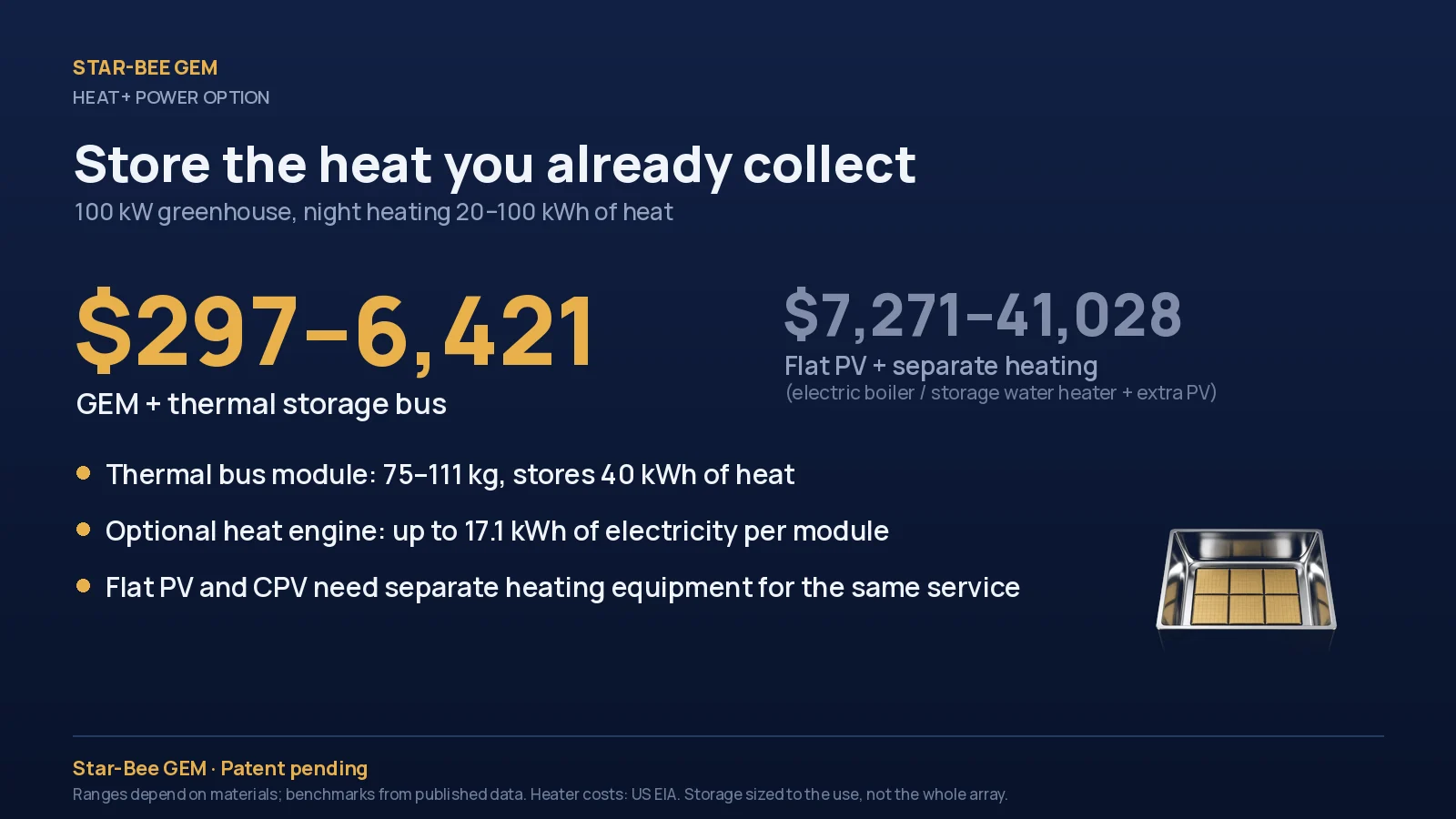
| Thermal storage bus (Star Vault 1–4, SKU-VAULT-1 to 4) | Optional modular heat storage sized to the use case, with an optional heat-to-power engine (SKU-ENG-1) | Thermal energy storage USD 2.5–8.1 B (Fortune Business Insights, IMARC); lunar habitat night survival | Module sales; system bundles with GEM and loop |
Thermal storage module: 40 kWh of heat (10 kW for 4 h), 75.0–111 kg, $594–2,568; the optional engine gives up to 17.1 kWh of electricity per module.
7. The space story
- Every kilogram counts. Launch is paid per kilogram. Today’s space arrays deliver ~30–100 W/kg; GEM optics reach 1,482 / 2,035 / 2,557 W/kg on the Moon.
- The mirror is the radiator. In vacuum, heat can only be radiated. Using the back face of the mirror as the radiator, a GEM on the Moon reaches 129 / 696 / 998 W/kg with one shared coolant loop and pump «calculated by Bot».
- Cheaper per delivered watt. Delivered to LEO (hardware + launch), the GEM is $1.20 / $21.1 / $98.9 per watt vs $251 / $475 / $1,112 for flat III-V arrays «calculated by Bot».
- Heat when the Sun is gone. The optional storage bus keeps a lunar habitat warm through the 14-day night, sized to the habitat, not the array.
- Next steps: thermal-vacuum testing of the mirror-back radiator, radiation and dust tests, and a full flight mass budget (see Space challenges & solutions).
Space challenges & solutions →
Notes on figures
- Moon specific power: up to ~2,557 W/kg = the Earth design maximum (~1,880 W/kg) × 1.36 for lunar sunlight. This replaces the higher Moon maximum shown earlier on the site, which used a different sunlight factor.
- Figures are design values; radiator, frame, wiring and deployment mass are added where stated. Thermal-vacuum and flight tests are still to come.
Farm, project-scale and learning-curve costs are full system (optics, cells, radiator, electrical, optional battery); frame, tracker, installation and launch are excluded. Rows labelled optics + cells only exclude electronics, battery, radiator, frame, tracker and assembly; cell price is a public price ($7.50 | $59 | $180 per cm²), not in source.
Block physics from the Star-Bee source workbook; totals, $/W and scale values calculated by Bot; capacity factors and benchmarks from cited public data.